A web page that edits itself.
Open it, sign in with your key, type, press Save. It lives on Nostr, so there is no server to run and no account to open.
Free to try. The example page is yours to type in, and nothing you type is kept.
Marta's Bread
Sourdough and rye from a wood oven. Come early, the dark loaves go first.
- Tuesday to Friday
- 7:00 to 14:00
- Saturday
- 7:00 to 12:00
- Rye, 1 kg
- 4.20
Press Save and three things happen.
The page copies itself.
It takes its own text and pictures as they are now and packs them into one file.
The copy is stored.
A storage server, called Blossom, keeps the file under a name made from its contents, so nobody can swap it quietly.
One signed note goes out.
It says: this address now shows that file. Relays pass it on. That note is the publishing.
Nothing in this is a server you run. Relays keep the note, Blossom keeps the file, and your browser does the rest. Who may edit the page is decided by a key, not by a line in somebody else's database. This page is one of those documents, and it saves itself the same way.
Twelve starting points, all free.
A template is a small application that happens to be one file. Pick one, put your own words in, and it is yours.
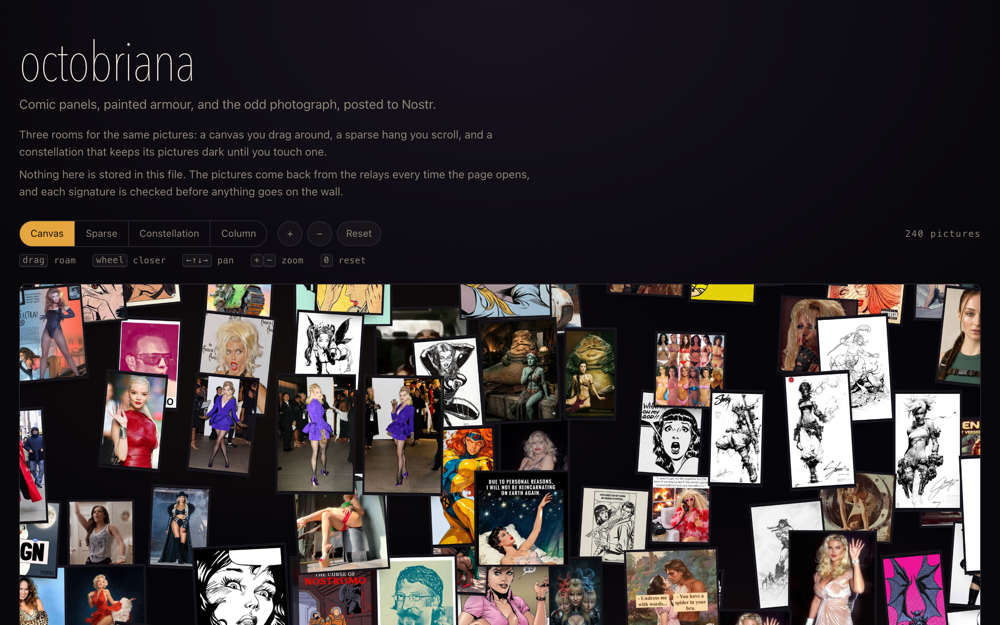 Photo galleryHundreds of pictures on a canvas you drag and zoom.
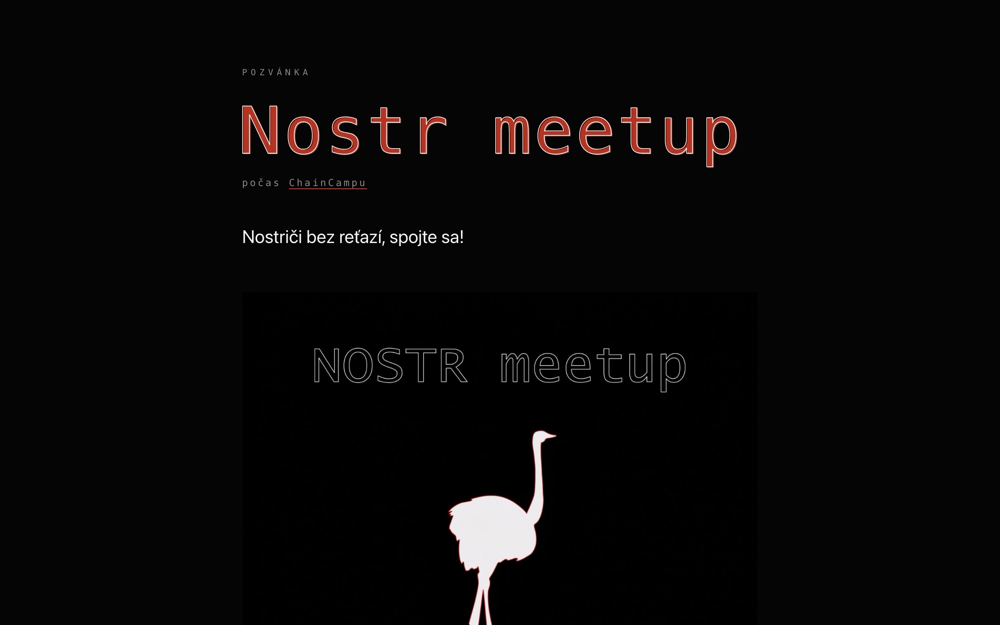 Event invitationDetails big enough to read across a room, and a calendar file to download.
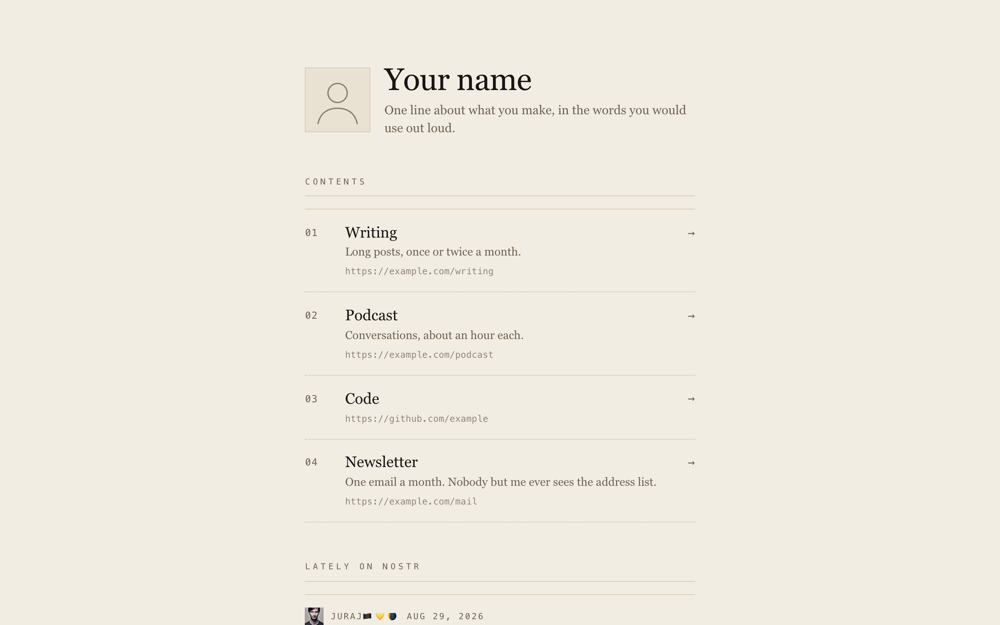 Link listA linktree you edit on the page itself.
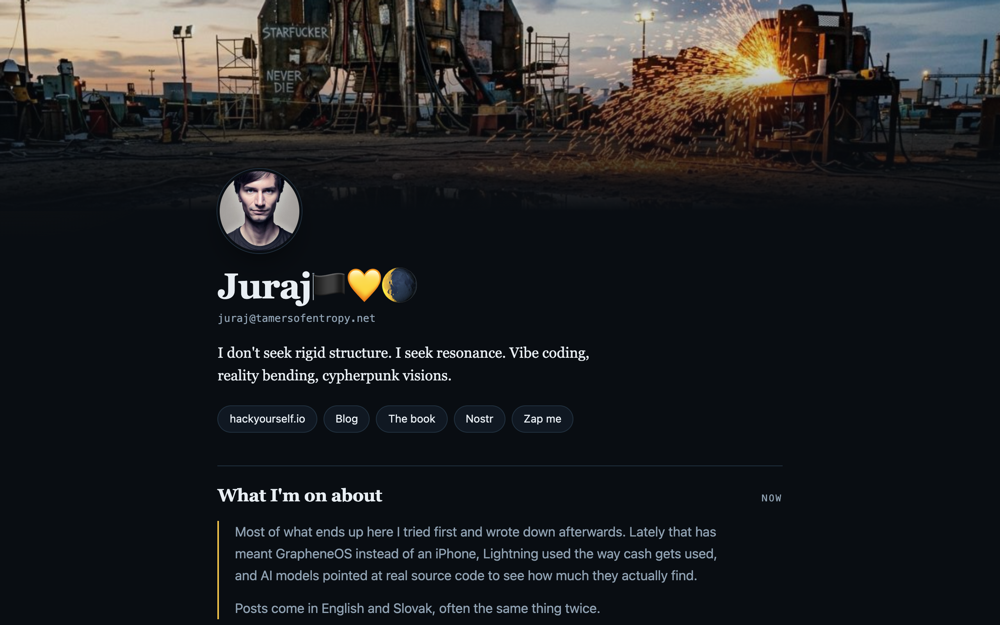 Personal homepageWho you are and what you write, notes and articles included, at one address that is yours.
What the project posted lately.
The project's own notes and articles, read from Nostr relays and signature-checked in your browser.
Ask AI to write it. Pay once, keep what is left.
Describe the page you want and AI writes it: the layout, the style, the text, and empty frames for your own photos. Look at the preview, ask for changes, and publish it with your own key.
On a page that is already online, press Edit with AI and say what should change, in the whole page or only the part you clicked. Nothing reaches the page until you keep the result. Undo takes it back.
- Supports nsite-clay1000
- Your own AI credit1000
One Lightning payment. The credit is yours, and what you do not spend can be withdrawn. A whole page costs roughly 20 sats, so 1000 covers dozens of pages or hundreds of edits.
AI is an extra. Everything else stays free: the editor, the twelve templates, the block composer and publishing never ask for payment.
Prefer not to pay us? Point the AI settings at any other Routstr node, or bring your own key for any OpenAI-compatible service. Terms, refunds and support are on the terms page.
Rather use the command line?
# make a site and a key for it
npx nsite-clay init mysite

# publish it
npx nsite-clay deploy mysite --sec=nsec1…

# or sign through a remote signer
npx nsite-clay deploy mysite --bunker="bunker://…"
Your site is served at https://<npub>.nsite.lol/ and by any other NIP-5A gateway.
Most pages made this way will be built by an agent. Point yours at llms.txt, a brief written for exactly that. For a site that is already online, llms-edit.txt is the second one.
What it does not do.
- One key writes the page. No shared editing and no per-visitor content.
- Two devices editing at once will lose one side. There is no way to detect the clash.
- The gateway is trusted for the first byte. Everything after it is checked by hash.
- No server code. If your project needs a backend, this is the wrong tool.
Try it with a real key.
A live page is published under a throwaway key, and the key is public on purpose. Open it, press Sign in, paste the key, and edit. Your save rewrites that page for everyone, so treat it as a sandbox and never paste a key you care about into a page you did not publish yourself.